Back
Anecdotally
 In keying these little stories I began to think of the challenges (and opportunities) to which historians must relate. In these current times we hear much of "fake news" but in reality there has always been some element of subjectivity in reporting/journalism/history. It has been said "History is written by the victors". Winston Churchill reportedly said "And history will show (and I know this because I shall write it) .." Indeed, he did go on to write "The History of the English Speaking Peoples" which (we may well suppose) was a factor in the award of his Nobel Prize for Literature. I include this preamble to set the stage for the following ramble, i.e., it is mostly unverifiable, just what my father told me over the years and for which corroboration is no longer available.
Walter Spring, August, 2020
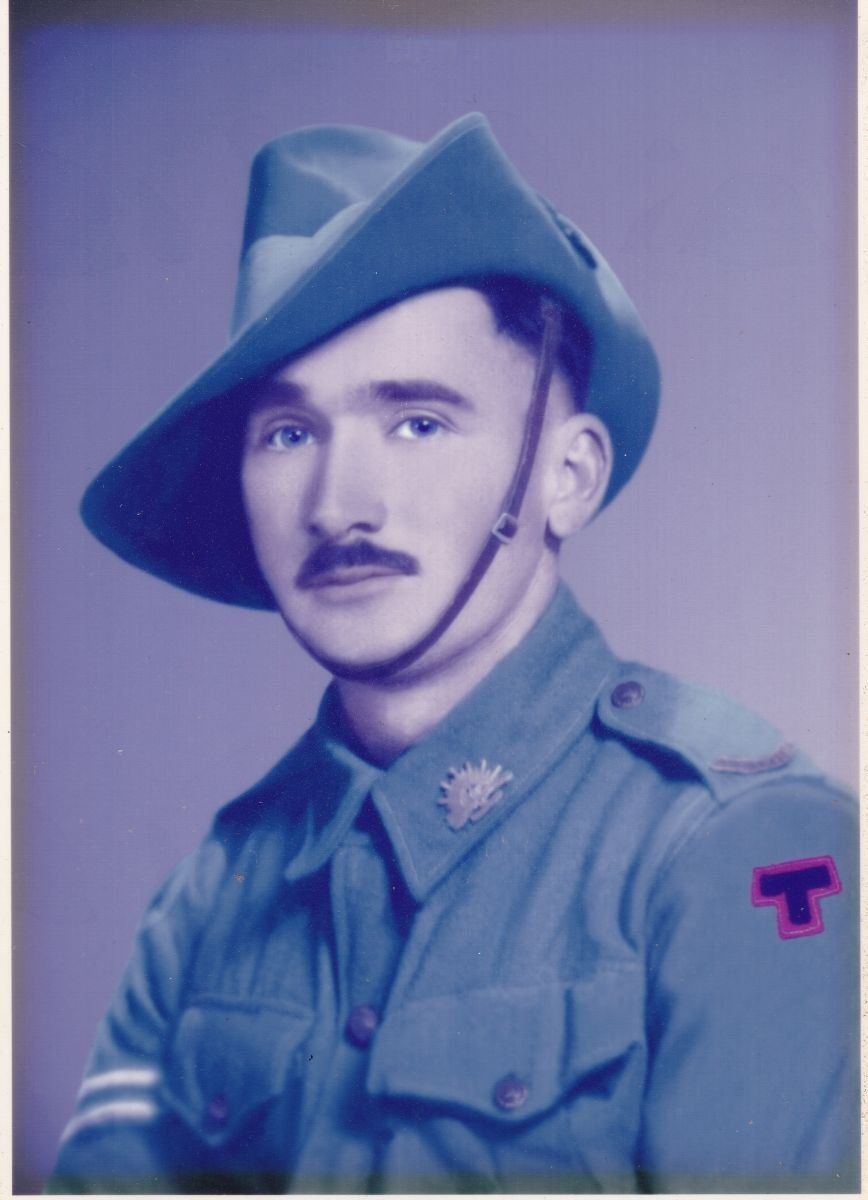
When war was declared, on 3.Sep.39, Clarrie was keen to join up but his best mate, Jack Young (later to become his brother-in-law) was unwell so he waited till they could both join at the same time. As it turned out they were assigned to different battalions and never served together. So it was on 5.Apr.1940 that he enlisted. Along with many other members of the Second AIF he went to England. They travelled on the Queen Mary, a cruise liner fast enough (about 30 knots) to sail with no escort ships.
Clarrie told of snow 4' deep in Essex during the Winter of 1940/41. At the time he and many others were waiting for the invasion that never came. A google search turned up a report that the Winters in the early 40s were quite harsh in Europe with snow drifts in England as much as 15' deep. There are also some reports that on the Eastern Front more German soldiers froze to death than were despatched by the Soviet forces.
Clarrie was at Tobruk when the siege began on 10.Apr.41. During his time at Tobruk he had some very close calls. There was the time an enemy round came so close that while it did not actually hit him, it did cut the chin stap of his hard hat. Another time he and "Jeff" (Arthur Jeffrey) were carrying a case of ammo up to the front and discovered when they got there that enemy fire had penetrated the case - fortunately not detonating the contents.
Once when he was in the hospital at Tobruk he decided he was well enough to pop down to the port to farewell some of his comrades being evacuated. In his absence there was an air raid and when he got back there was a large crater where his bed had been.
He came across a recently deceased Italian soldier still equipped with his side-arm, a 9mm Beretta, by all accounts a fine weapon. He left the soldier as he was but took the pistol and stowed it in his backpack. Some little while later, during an artillery attack, this same pistol was destroyed by shrapnel, giving its life for its new owner.
Along with most (but not all) of the Australian troops, Clarrie was evacuated before the siege was broken on 10.Dec.41 by Allied forces advancing from Egypt. The ship on which Clarrie was evacuated was the mine laying cruiser Abdiel. There are conflicting reports of the ship's top speed but there is little doubt the only defensive weapons she carried were against aircraft - too fast even for torpedoes to catch her.
He was in Syria in 1942, in snow well more than knee deep. Whether this was the winter of 1941-42 or 1942-43 we do not know but the photo in the Pictorial Gallery is endorsed in Clarrie's handwriting "Syria, 1942". But we do know he was at El Alamein in late October of 1942 because he was there for the Battle of El Alamein. Churchill reportedly said of this battle, "It was the watershed - before it we never won a battle, after it we never lost". Little wonder that in his twilight years Clarrie was not at all interested in Brisbane City's "Riverfire" display of fireworks - on the opening night of the Battle of El Alamein the Allies fired off more than 500,000 rounds of artillery to which the Axis made a worthy (if inadequate) response.
Although his official rank was usually NCO (Corporal or Sergeant), there were times during battle when officers were killed, wounded, or otherwise unavailable and it was Clarrie who stepped up to lead the fight, at times leading a force normally commanded by a Lt.Colonel.
As the Japanese advanced towards Australia, Clarrie was among those sent back to defend the homeland. He did briefly see some service in Papua New Guinea but before long the medical people decided he had seen enough action and gave him a medical discharge.